Real-time YOLO semantic segmentation
Understand entire scenes with dense per-pixel class labels. Ultralytics semantic segmentation models classify every pixel — roads, vegetation, buildings, products — with the same fast training and deployment workflow as every YOLO task.
YOLO26 semantic segmentation models
YOLO26-sem models label every pixel in the scene, reported below as mean IoU at 1024×2048 resolution. Five sizes span edge deployment through accuracy-critical mapping, and additional 640-pixel variants are documented for lighter workloads.
pip install ultralyticsfrom ultralytics import YOLO
# Load a YOLO26 semantic segmentation model
model = YOLO("yolo26n-sem.pt")
# Run inference
results = model("image.jpg")| Model | Size (px) | mIoU | RTX 3090 PyTorch (ms) | Params (M) | FLOPs (B) |
|---|---|---|---|---|---|
| YOLO26n-sem | 1024 × 2048 | 78.3 | 4.4 ± 0.0 | 1.6 | 22.7 |
| YOLO26s-sem | 1024 × 2048 | 80.8 | 8.4 ± 0.0 | 6.5 | 88.8 |
| YOLO26m-sem | 1024 × 2048 | 82.0 | 19.9 ± 0.1 | 14.3 | 304.5 |
| YOLO26l-sem | 1024 × 2048 | 82.9 | 26.5 ± 0.1 | 17.9 | 384.7 |
| YOLO26x-sem | 1024 × 2048 | 83.6 | 48.9 ± 0.2 | 40.2 | 861.7 |
YOLO26 semantic segmentation benchmarks at 1024×2048 from the Ultralytics docs.
Trusted by the world's leading organizations












Our models' impact
Streamline processes across industries with our cutting-edge vision AI models. Speed, accuracy and ease-of-use powered by Ultralytics.
The evolution of Ultralytics YOLO models
See how Ultralytics YOLO evolved from the practical YOLOv5 workflow to edge-ready YOLO26 inference.
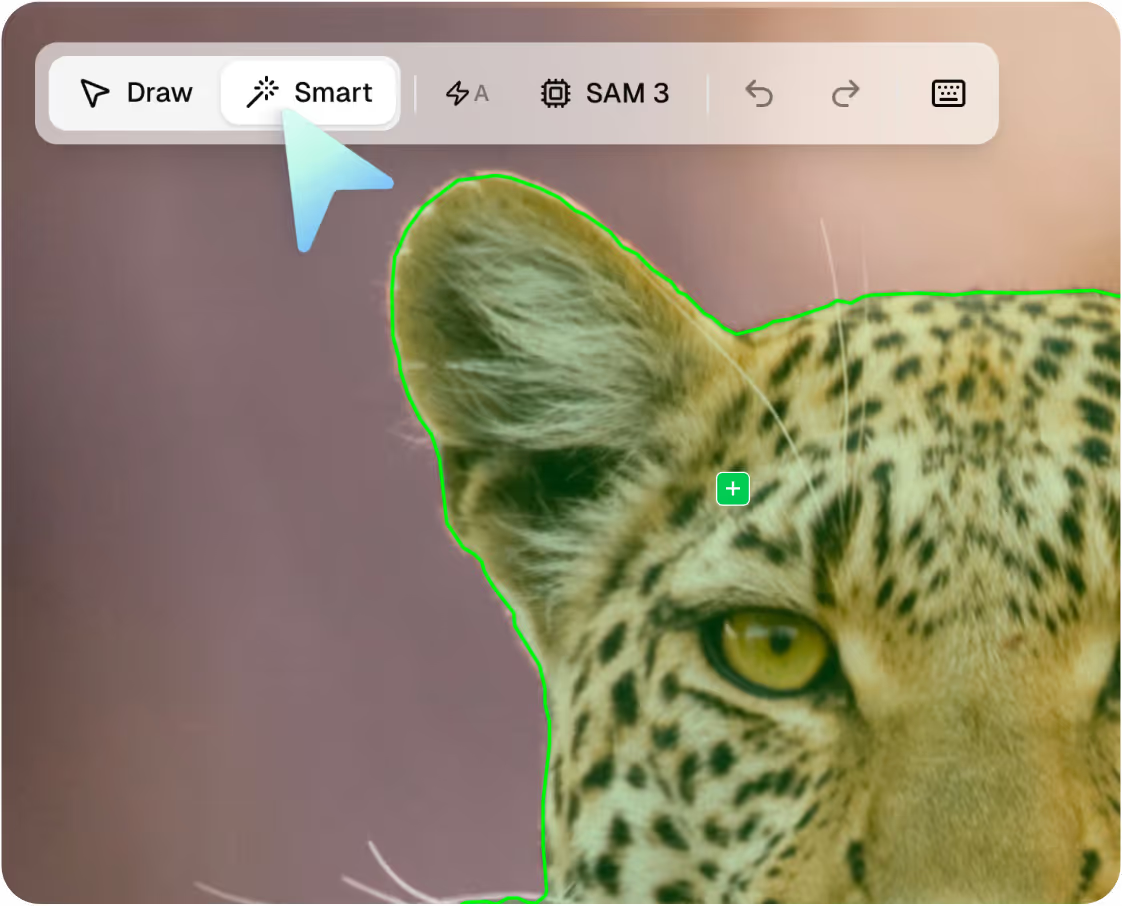
Label up to 10x faster with smart annotation
Ultralytics Platform gives you the image annotation tool to build high-quality datasets faster. From smart annotation to precise manual editing, these features are designed to reduce image labeling time without sacrificing quality.
- SAM-powered smart annotation: Masks and bounding boxes in one click.
- Full AI task coverage: Detection, instance segmentation, semantic segmentation, classification, pose, OBB.
- Universal format support: Your choice of YOLO, COCO, and more.
- Team review and versioning: Clear collaboration at every step.
Train on the Best GPUs for Less
26 NVIDIA GPUs starting at $0.24/hr — from Ampere to Blackwell. No markup, no minimums, no commitment.
Explore industry solutions
See how teams apply Ultralytics computer vision across production environments.

Agriculture

Automotive

Healthcare

Logistics

Manufacturing

Retail

Robotics
Agriculture
Automotive
Healthcare
Logistics
Manufacturing
Retail
Robotics
Agriculture
Automotive
Healthcare
Logistics
Manufacturing
Retail
Robotics
Frequently asked questions
Semantic segmentation assigns a class label to every pixel in an image, producing a dense map of the full scene rather than boxes or per-object masks. It answers questions like which pixels are road, water, crop, or defect — the foundation for scene understanding in mobility, agriculture, inspection, and mapping.
Semantic segmentation labels every pixel by class without separating individual objects — all cars share one label. Instance segmentation produces a distinct mask per object, so you can count and track them. Use semantic segmentation for scene-level understanding, instance segmentation for object-level analysis; Ultralytics supports both with one workflow.
Ultralytics semantic segmentation models are the first in the YOLO family to produce dense per-pixel labels, announced on the Ultralytics roadmap and documented in the semantic segmentation docs. They share the familiar Ultralytics training, validation, and export workflow.
Prepare per-pixel masks for your classes and run the Ultralytics library's train mode, or manage annotation, cloud GPU training, and evaluation in the browser with Ultralytics Platform. Fine-tuning pretrained weights is the fastest path to strong results.
Export with export mode to formats such as ONNX, TensorRT, and OpenVINO for real-time inference on edge devices, vehicles, and servers. Dense per-pixel outputs come directly from the exported model, keeping downstream pipelines simple.
Build semantic segmentation with Ultralytics
Train dense per-pixel segmentation models and deploy them anywhere with Ultralytics Platform.